Short summary
People often hear the word “evolution” and imagine one animal suddenly turning into another. That is not how biologists use the word. Evolution is the long-term change of inherited traits in a population. It works across generations, not inside one individual lifetime.
The four ideas that make evolution easier to understand
If you are new to the topic, keep these four ideas in mind.
1. Individuals in a population are not identical
No two wolves, oak trees, or bacteria are exactly the same. They differ in size, color, behavior, chemistry, and many other traits. Some of those differences come from inherited differences in DNA.
2. Some differences can be passed on
If a trait is inherited, parents can pass it to offspring. That does not mean every trait is controlled by one simple gene, but it does mean useful, harmful, or neutral differences can move from one generation to the next.
3. Environments affect which traits are helpful
A trait that helps in one setting may not help in another. Thick fur is useful in cold places but can be a burden in hot places. Camouflage helps only if something is trying to see you. Evolution is tied to real conditions, not to abstract ideas of “better.”
4. Time matters
Small differences can add up when they are filtered across many generations. That is why evolution can produce large changes without requiring sudden leaps.
The main processes you will meet
- What is evolution? explains the core idea in plain language.
- Natural selection explains how certain inherited traits can become more common.
- Mutation explains where new inherited differences come from.
- Genetic drift explains how chance alone can shift a population.
- Speciation explains how one lineage can split into two or more species.
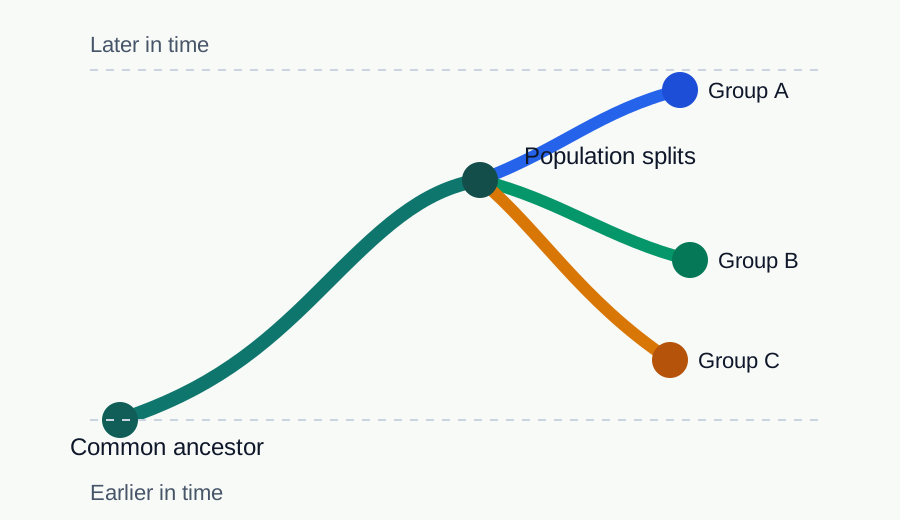
These processes are related. Mutation introduces new variation. Selection and drift affect which variants become common. Over long periods, separated populations can diverge enough to become different species.
Evolution is not only about ancient history
Evolution is happening now. We see it in bacteria that become harder to kill with drugs, in viruses that change over time, in insects that become resistant to pesticides, and in breeding programs that shape crops and animals.
That is why evolution is not just a topic for museums. It matters in medicine, farming, conservation, and public health.
A useful mental picture
Think of evolution as editing a long family story. Each generation copies most of what came before, but not perfectly. Small inherited differences appear. Some spread because they help in a certain environment. Some spread by luck. Some disappear. Over enough time, the story branches.
Common mistakes to avoid at the start
- Evolution does not mean effort. Animals do not evolve because they try hard.
- Evolution does not mean progress toward perfection. There is no built-in ladder that life is climbing.
- Evolution does not mean one individual changes into a new species.
- Evolution does not require every change to be useful.
How to use this section
If you want the best order for learning, read:
After that, move to the evidence section to see how fossils, DNA, and direct observation support these ideas.