Short summary
Speciation is how one evolutionary line can split into two or more species. It helps explain why life forms a branching tree rather than one straight chain.
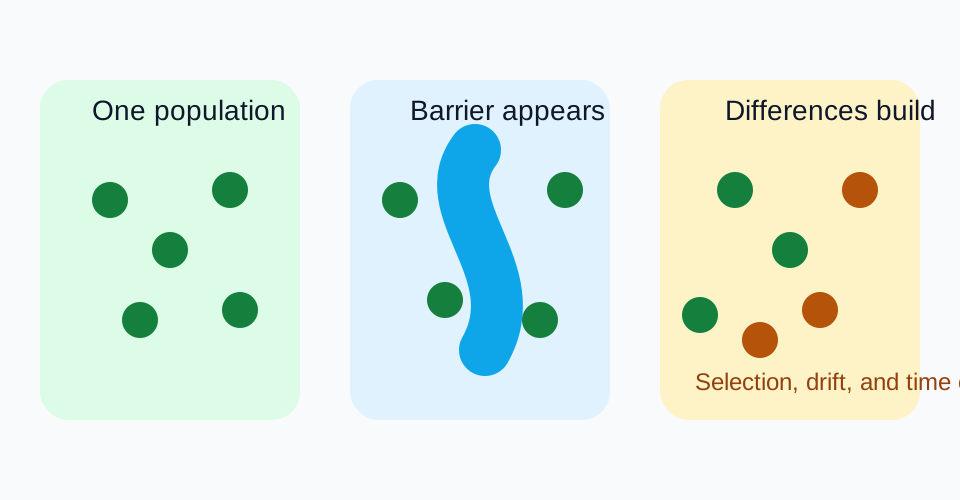
Why species split
Populations do not always stay mixed forever. Mountains rise, rivers change course, islands form, climates shift, and groups spread into new habitats. When populations stop exchanging many genes, they can begin to change in different ways.
Over time, those differences can build up until the groups no longer interbreed successfully, or do so only rarely. At that point, scientists may recognize them as separate species.
The most common pattern: separation first
One of the most common routes to speciation begins with separation.
- One population is divided into two groups.
- The groups experience different mutations, selection pressures, and random drift.
- The groups become more different over time.
- Reproduction between them becomes difficult or stops.
This process is often called allopatric speciation, but the main idea is more important than the label: separation gives populations room to diverge.
More than one process is involved
Speciation does not happen because of a single force.
- Mutation introduces new variation.
- Natural selection can favor different traits in different places.
- Genetic drift can push small populations apart by chance.
Over long periods, these influences can combine.
Reproductive isolation in plain language
Biologists often talk about reproductive isolation. This means the groups are no longer exchanging genes in the way they once did. That can happen for different reasons.
- They may live in different places.
- They may breed at different times.
- They may prefer different mates.
- Their offspring may be less viable or less fertile.
Not all species fit one perfect rule, but the broad idea is that separate lineages stop blending back together.
A branching pattern, not a ladder
Speciation is one reason the history of life looks like a tree. One line can split into two. Those two lines can later split again. Over deep time, many branches appear.
This is also why modern species are cousins, not stages in a single chain. Humans are not “more evolved” than birds or fish. We are all current branches of the same long tree of life.
Fossils and DNA both matter here
Evidence for speciation does not come from one source. Fossils can show changing forms over time. DNA can reveal how closely populations are related. Together, these lines of evidence help scientists reconstruct branching history.
You can see more of that on the pages about fossil evidence and genetic evidence.
A simple analogy
Think about languages. If one language-speaking group is split into separate communities for a long time, the speech of each group can drift. New words appear, pronunciations change, and grammar shifts. After enough time, the communities may no longer speak the same language.
Speciation is not exactly like language change, but the analogy helps: separation plus time can turn one line into several.
What speciation does not mean
- It does not mean every new species appears suddenly.
- It does not mean there is always one exact generation when a line “becomes” a species.
- It does not mean evolution always moves in a straight line from simple to advanced.
Why this matters
Speciation explains the richness of life. It is how one ancestral population can eventually give rise to many related forms. Without speciation, the diversity of life around us would be much harder to understand.