Short summary
Natural selection is one of the best-known ways evolution happens. If an inherited trait helps organisms survive or reproduce in a certain setting, that trait can become more common over generations.
The basic idea
Natural selection sounds complicated, but the core logic is simple.
- Individuals in a population differ from one another.
- Some of those differences are inherited.
- Those differences affect how many offspring individuals leave.
If all three are true, the population can change over time.
Selection does not create traits on demand
This point is important. Natural selection does not invent useful traits because an organism needs them. Selection can only work on variation that already exists. New variation comes from processes such as mutation and reshuffling of inherited DNA.
You can think of natural selection as a filter rather than a designer. It sorts what is already there.
Why environment matters
A trait is not simply “good” or “bad” everywhere. It depends on the environment.
- Thick fur may help in a cold climate but hurt in a hot one.
- Bright feathers may help attract mates but also attract predators.
- A gene that protects against one disease may come with costs in another setting.
Natural selection is always local. It acts in the real conditions an organism faces.
A classic camouflage example
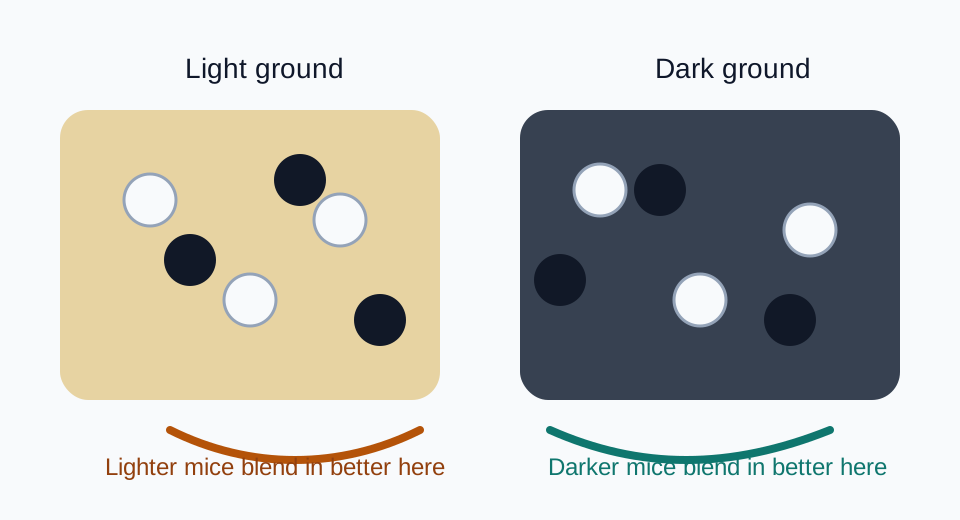
Imagine mice living on pale sand. Light-colored fur may help them blend in. If predators spot dark mice more easily, those dark mice may leave fewer offspring. Over time, the population may shift toward lighter fur.
Now change the ground to dark volcanic rock. The pattern can reverse. Suddenly dark fur may be the better camouflage.
This example shows two key points:
- selection depends on the environment
- evolution can be observed as trait frequencies change
Survival is only half the story
People often summarize natural selection as “survival of the fittest,” but that phrase is incomplete if readers think only about staying alive. In biology, reproductive success matters just as much. An organism that survives but leaves no offspring does not pass on its traits.
That is why traits involved in attracting mates, caring for young, or competing for breeding opportunities can also be shaped by selection.
Selection is not a conscious force
Natural selection does not think ahead. It does not plan for the future. It does not aim at perfection.
This is why evolution often produces workable solutions instead of ideal ones. Organisms are built from what history has provided, not from a fresh engineering plan. That is one reason living things contain odd compromises and imperfect structures.
Selection can be strong or weak
In some cases, selection is dramatic. A pesticide may kill most insects except those carrying a resistant variant. In other cases, the difference is small, and changes build slowly over time.
Even a small advantage can matter if it repeats generation after generation.
Natural selection is not the only cause of evolution
Selection is important, but it is not the whole story. Genetic drift can also shift traits by chance, especially in small populations. That means not every feature that becomes common did so because it was useful.
This is one reason evolutionary explanations need evidence rather than guesswork.
Real-world examples
Natural selection helps explain:
- bacteria that survive antibiotics
- insects that survive pesticides
- plants that match local climates
- changes in viruses as they spread
You can read one especially important example on the page about antibiotic resistance.
A simple test for your understanding
When you look at an example, ask:
- Is there inherited variation?
- Does that variation affect survival or reproduction?
- Could the environment make one version more successful than another?
If the answer is yes, natural selection may be part of the explanation.