Short summary
Mutation is a change in DNA. DNA is the information-carrying material in cells. When DNA changes, the result may be invisible, harmful, helpful, or somewhere in between. Mutations matter because they are one important source of new inherited variation.
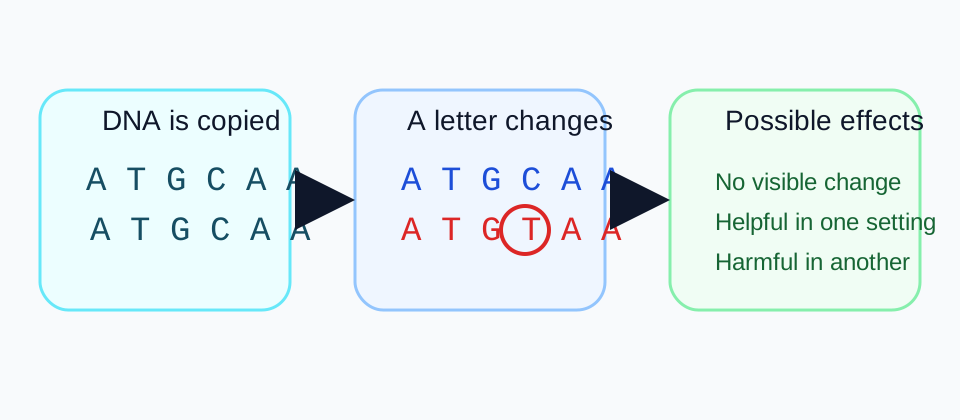
What a mutation actually is
DNA is built from chemical units often described as letters. A mutation happens when the DNA sequence changes. Sometimes one letter changes. Sometimes a piece is removed, repeated, or moved.
Not every mutation changes a visible trait. Some do not affect how a protein is built. Some happen in regions of DNA that do not change a trait in an obvious way. Others can have major effects.
How mutations happen
Mutations can arise in several ways.
- DNA may be copied imperfectly when cells divide.
- Radiation or certain chemicals can damage DNA.
- Some viruses can insert genetic material into a host genome.
- Normal cellular processes can sometimes create copying errors.
Cells also have repair systems. Many DNA problems are fixed before they are passed on. So mutation is real, but cells are not helpless.
Why most mutations are not dramatic
Movies often make mutation look instant and extreme. Real biology is usually quieter.
Many mutations have little or no visible effect. Some are harmful because they disrupt an important function. A smaller number can be useful in a certain environment.
The effect depends on at least three things:
- where in the DNA the change occurs
- what the mutation changes in the organism
- what environment the organism lives in
That last point matters a lot. A mutation that helps in one setting may do nothing in another.
Mutation and evolution are not the same thing
Mutation creates variation. Evolution is the change in inherited traits in a population over time. Mutation is one ingredient, not the whole process.
An easy way to remember this is:
- mutation introduces new cards
- natural selection and genetic drift affect which cards stay common
Without mutation, populations would have far less new raw material for long-term change.
When mutations can spread
A mutation can become common in several ways.
- It may help survival or reproduction, so selection favors it.
- It may spread by chance, especially in a small population.
- It may remain rare or disappear.
There is no rule saying a new mutation must spread. Most do not.
A real-world example: antibiotic resistance
If a bacterial cell has a DNA change that helps it survive an antibiotic, that cell may keep growing while many others die. The mutation did not appear because the bacterium wanted to resist the drug. The mutation already existed or arose by chance. The antibiotic then changed which cells survived.
This is why antibiotic resistance is such a useful example when learning evolution.
Mutations in body cells and reproductive cells
Not every mutation matters equally for evolution. A mutation in a body cell may affect that individual but usually will not be passed to offspring. For evolution, the most important mutations are the ones that can enter the next generation.
Common misunderstandings
- Mutation does not mean “always harmful.”
- Mutation does not mean “always visible.”
- Mutation does not mean “a planned response to need.”
- Mutation alone does not explain adaptation.
Why this topic matters
Once you understand mutation, you can see why evolution has fresh material to work with. Populations are not fixed collections of traits. New inherited variation continues to appear, and that is one reason life can keep changing.