Short summary
Evolution is the long-term change of inherited traits in populations. It is one of the main ideas in biology because it helps explain why living things are similar in some ways, different in others, and connected through common ancestry.
The simple meaning of the word
In everyday conversation, people use “evolve” to mean almost any kind of change. In biology, the meaning is narrower and more useful. Evolution is not just change. It is inherited change in a population across generations.
That definition matters because many things change without evolving. A person gets taller while growing up, but that is development, not evolution. A lizard loses its tail in an accident, but that change is not inherited by its offspring. Evolution only applies when inherited traits in a population shift over time.
Why populations matter more than individuals
An individual organism does not evolve in the full biological sense. A rabbit may adapt to cold weather in the short term by changing its behavior, but its genes do not rewrite themselves because it wants to survive. Evolution happens when some inherited traits become more common, less common, or split into new combinations over many generations.
That is why biologists talk about populations. A population is a group of the same species living in the same area and breeding with one another. When the inherited mix of traits in that group changes over time, evolution has occurred.
What makes populations change
Several processes can drive evolutionary change.
- Mutation creates new DNA changes.
- Natural selection can increase traits that help survival or reproduction in a particular environment.
- Genetic drift can shift traits by chance, especially in small populations.
- Movement between populations can also change the genetic mix when individuals migrate and breed.
These processes do not all push in the same way. Sometimes they reinforce each other. Sometimes they pull in different directions.
A real-life example
Imagine a population of insects living on green leaves. Some are easier for birds to see. Some are harder to see. If the better-hidden insects leave more offspring, the population may gradually become harder to spot. That shift is evolution. It did not happen because the insects decided to change. It happened because inherited differences affected survival and reproduction.
Evolution does not mean “everything is random”
People often hear about random mutation and assume evolution itself is random. That is incomplete. Some variation appears without regard to what an organism needs, but the spread of that variation is often shaped by non-random forces such as natural selection.
In other words, new cards may be dealt without a plan, but the environment strongly affects which cards stay in the game.
Evolution also explains relationships
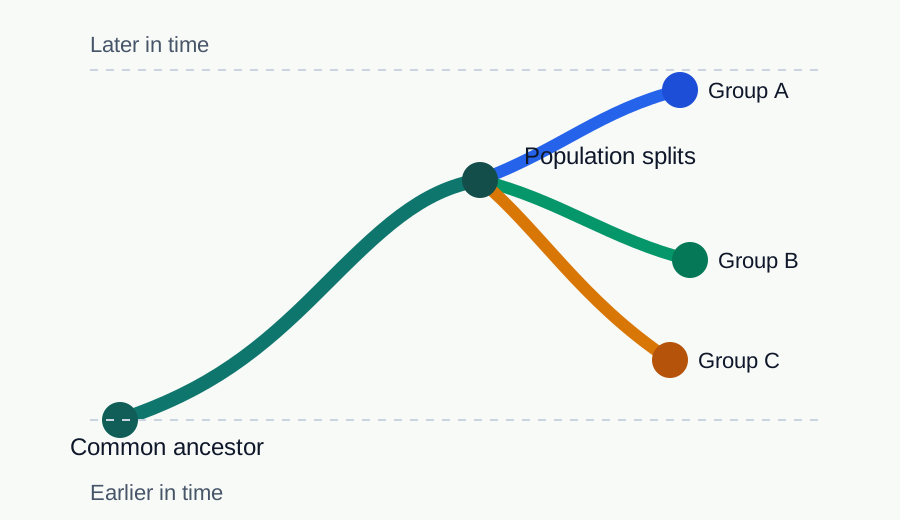
Evolution is not only about change. It is also about connection. Humans, whales, oak trees, mushrooms, and bacteria do not form one flat list of unrelated life forms. They are part of a branching history. The idea of speciation explains how one lineage can split into multiple lineages over time.
That branching pattern is why scientists talk about common ancestry. Different species may look very different today, but they can still share ancestors if you go back far enough.
Why this idea is so important
Without evolution, many facts in biology would sit side by side without a clear link between them. Evolution helps connect them:
- why fossils appear in a time order
- why related species share body plans
- why DNA can reveal family relationships
- why bacteria become drug resistant
- why viruses change over time
This is why evolution is often called the organizing idea of biology.
What evolution does not say
Evolution does not say that:
- life has a fixed goal
- every trait is an adaptation
- every change is helpful
- humans came from modern monkeys
- one species suddenly becomes another in a single generation
Those are common misunderstandings, and several are covered in the misconceptions section.
A good next step
If this page makes sense, the next page to read is natural selection. It explains one of the most important ways evolutionary change happens.