Short summary
Not every evolutionary change happens because a trait is useful. Sometimes a population changes simply because of luck. That process is called genetic drift.
The basic idea
Imagine flipping a coin ten times. You might get exactly five heads and five tails, but you might not. With only a few flips, chance can push the result away from a perfect fifty-fifty split.
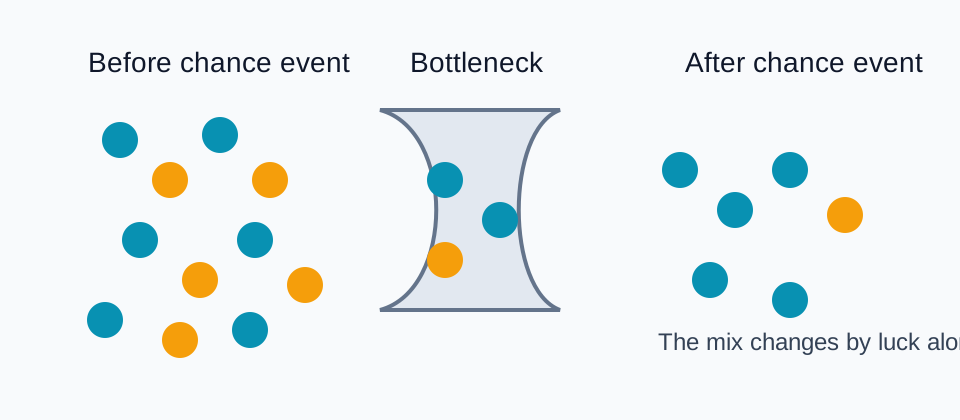
Genetic drift works in a similar way. The next generation is not a perfect copy of the current one. It is a sample. By chance alone, some genetic variants may become more common and others less common.
Drift is about randomness, not usefulness
This is what makes drift different from natural selection. In selection, a trait spreads because it affects survival or reproduction in a particular environment. In drift, a trait can spread even if it has no advantage at all.
That does not mean selection stops existing. It means populations can be influenced by more than one process at the same time.
Why small populations are most affected
Chance matters more when the numbers are small. If a very large population loses a few individuals at random, the genetic mix may barely change. If a small population loses a few individuals, the effect can be large.
That is why genetic drift is especially important in:
- small island populations
- populations that have shrunk after disease, fire, or habitat loss
- newly founded populations started by a few individuals
Two important patterns: bottlenecks and founder effects
Bottleneck
A bottleneck happens when a population suddenly becomes much smaller. The survivors are only a sample of the earlier population, so some variants may be lost by chance.
Founder effect
A founder effect happens when a small number of individuals start a new population. The new population carries only part of the original genetic variation. As a result, some traits may be unusually common or rare in the new group.
Drift can reduce variation
One long-term result of drift is that it can remove genetic variation from a population. If variants disappear by chance and are not replaced, the population may become less diverse.
That can matter in conservation biology because less genetic variation may make populations less able to respond to future environmental change.
Drift and speciation
Drift can also help separated populations become more different from one another. If two small groups are isolated, random changes can pull them apart over time. Combined with mutation and selection, this can contribute to speciation.
A useful everyday analogy
Imagine a classroom picking colored beads from a bag to build the next bag. If the class picks only a few beads, the color mix can swing a lot by chance. If the class picks thousands of beads, the new mix is more likely to match the old one.
That is the logic behind genetic drift.
Common misunderstandings
- Genetic drift is real evolution because the population changes over generations.
- Drift does not require a trait to be good or bad.
- Drift is not rare. It affects all populations, though its effects are easier to see in small ones.
Why this topic matters
Genetic drift reminds us that evolution is not only a story of adaptation. Some features of populations reflect chance, history, and sample size as much as they reflect usefulness.